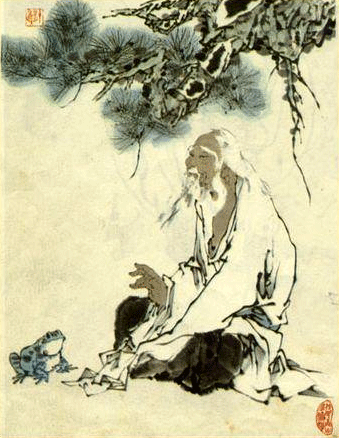
Illuminating the Void: The Wisdom of Emptiness
Chuang Tzu's assertion that "the empty room is filled with light" invites us to reconsider our understanding of emptiness and fullness. In a world often dominated by material pursuits and the clamor of existence, this quote serves as a gentle reminder that true illumination arises not from accumulation but from the space we create within ourselves. It beckons us to explore the profound potential that lies in emptiness, suggesting that within the void, we may discover a radiant clarity that transcends our conventional notions of fulfillment.
As we delve deeper into this statement, we begin to recognize that the "empty room" is not merely a physical space but a metaphor for the mind and spirit. In our busy lives, we often fill our thoughts and hearts with distractions, leaving little room for introspection and genuine connection. Chuang Tzu's wisdom encourages us to embrace the stillness and silence that emptiness offers, allowing light—symbolizing insight, awareness, and understanding—to permeate our being. This exploration of emptiness is not a denial of existence but an invitation to engage with the essence of life itself.
The image / the metaphor
The imagery of an "empty room" evokes a sense of spaciousness and tranquility. It conjures a place devoid of clutter, where the mind can rest and the heart can breathe. The choice of the word "filled" juxtaposes the concept of emptiness with the presence of light, suggesting that what we often perceive as absence is, in fact, a fertile ground for illumination. This paradox invites us to reconsider our relationship with emptiness, revealing it as a canvas upon which the light of understanding can be painted.
Diving deeper into the metaphor, we can see that the "light" represents not only knowledge but also the clarity that comes from stillness. In Taoist philosophy, light often symbolizes the natural flow of the Tao—the underlying principle that governs the universe. When we allow ourselves to experience emptiness, we create a space where the light of the Tao can shine through, illuminating our path and guiding us toward a more profound understanding of ourselves and our place in the world. This interplay between emptiness and light serves as a reminder that true wisdom often arises from moments of quiet reflection.
In the speaker's tradition
Chuang Tzu's teachings are deeply rooted in the Taoist tradition, which emphasizes the importance of harmony with the natural flow of life. Concepts such as "wu wei" (non-action) and "sunyata" (emptiness) resonate with the essence of his quote. Wu wei encourages us to act in accordance with the natural rhythms of existence, while sunyata invites us to recognize the inherent emptiness that underlies all phenomena. Together, these ideas suggest that by embracing emptiness, we can align ourselves with the Tao and experience the fullness of life in a more profound way.
A relevant text that echoes this sentiment is the "Tao Te Ching," where Laozi speaks of the value of emptiness in the context of a vessel. Just as a pot is defined by its empty space, so too are our lives enriched by the moments of stillness and quietude we cultivate. The teachings of both Chuang Tzu and Laozi remind us that the path to enlightenment is not found in the accumulation of knowledge or possessions but in the ability to embrace the emptiness that allows for true insight and understanding.
Living the teaching
Consider a modern scenario where this teaching might resonate: a busy professional overwhelmed by the demands of work and life. In the midst of deadlines and responsibilities, the individual may feel a sense of emptiness, a longing for clarity and purpose. By intentionally creating moments of stillness—perhaps through meditation or simply stepping away from the chaos—they can begin to experience the light that emerges from that emptiness. In these moments, they may find renewed inspiration and a deeper connection to their true self, illuminating their path forward.
This teaching can also be applied in relationships, particularly during difficult moments of conflict or misunderstanding. When tensions arise, it is easy to fill the space with words, accusations, or defenses. However, by embracing the emptiness of silence and allowing for reflection, both parties can create a space for understanding and healing. In this way, the empty room becomes a sanctuary for light to enter, fostering deeper connections and insights that might otherwise remain obscured by the noise of ego and emotion.
A reflection
As we contemplate Chuang Tzu's profound statement, we are invited to consider the nature of our own lives. What areas feel cluttered or overwhelming, and how might we create space for light to enter? In what ways can we embrace emptiness—not as a void to be feared, but as a fertile ground for growth and understanding? Reflecting on these questions can guide us toward a more harmonious existence, where the interplay of emptiness and light reveals the beauty of our journey.



Join the BrightStar Community
Stay connected with daily inspiration, event announcements, and community wisdom