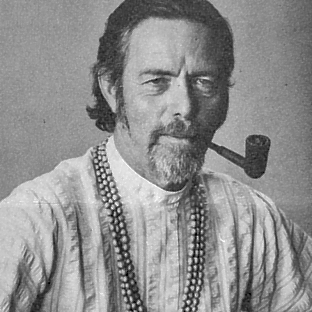
The Art of Presence: Engaging with the Now
Alan Watts invites us to consider a profound truth with his assertion that the essence of life lies in our complete engagement with the present moment. To be "completely engaged" suggests a depth of involvement that transcends mere participation; it calls for a full-bodied immersion in our current experience. This perspective is not merely a philosophical musing but a vital practice that can transform our daily lives, urging us to break free from the shackles of distraction and the weight of past regrets or future anxieties.
In a world increasingly characterized by fragmentation and busyness, Watts's words resonate with a clarion call to return to the here and now. The stakes are high: when we fail to engage fully with our present circumstances, we risk missing the richness of life itself. This teaching is not just about mindfulness in a superficial sense; it is about cultivating a deep, abiding presence that allows us to experience the fullness of each moment, fostering a sense of connection with ourselves and the world around us.
The image / the metaphor
At the heart of Watts's quote lies a vivid imagery of engagement, suggesting a dance with life that is both dynamic and fluid. The phrase "completely engaged" evokes a sense of surrender, where one is not merely an observer but an active participant in the unfolding of experience. The "here and now" serves as a grounding point, a reminder that life is not found in the distant future or the murky past, but in the immediacy of our current actions and thoughts. This imagery invites us to visualize ourselves as flowing with the currents of life, rather than resisting or clinging to what has been or what might be.
Diving deeper into this metaphor, we can see that engagement implies a relationship with our surroundings that is both intimate and responsive. It suggests a state of flow, akin to the concept of "wu wei" in Taoism, where action is effortless and aligned with the natural rhythm of existence. This state of being is not about striving or forcing outcomes but rather about allowing ourselves to be carried by the moment, embracing whatever arises with openness and curiosity. In this way, Watts's teaching becomes a pathway to liberation, encouraging us to let go of our preconceived notions and fully inhabit our experiences.
In the speaker's tradition
Alan Watts, a prominent figure in the popularization of Eastern philosophies in the West, draws heavily from Zen Buddhism and Taoist thought. His emphasis on presence and engagement resonates with the Zen concept of "mindfulness" or "sati," which encourages practitioners to maintain awareness of their thoughts, feelings, and actions in the present moment. This practice is closely related to the idea of "dharma," or the natural order of things, suggesting that by being fully present, we align ourselves with the fundamental truths of existence. In this context, Watts's teaching becomes a call to recognize the interconnectedness of all things, urging us to engage with life as it unfolds.
Moreover, Watts's insights can be illuminated through the lens of "sunyata," or emptiness, a core tenet in Zen that speaks to the fluidity and impermanence of all phenomena. When we engage fully with the present, we begin to see the transient nature of our experiences, allowing us to release attachments and embrace the moment as it is. This perspective echoes the teachings found in the Heart Sutra, which emphasizes that form is emptiness and emptiness is form, inviting us to experience the world without the filters of our judgments and expectations.
Living the teaching
Consider a modern scenario where this teaching might take root: imagine a busy professional caught in the whirlwind of deadlines and meetings. In such a context, the challenge is to remain present amidst the chaos. By consciously choosing to engage fully with each task—whether it be a conversation with a colleague or a moment of creative brainstorming—one can transform the mundane into a meaningful experience. This practice not only enhances productivity but also fosters a sense of fulfillment, as the individual learns to appreciate the richness of each moment rather than merely rushing through them.
Another application of Watts's teaching can be found in personal relationships. In moments of conflict or misunderstanding, the tendency is often to retreat into our own narratives, losing sight of the other person's perspective. By embracing the principle of complete engagement, we can cultivate a deeper connection with our loved ones. This means listening actively, being present in the conversation, and allowing ourselves to be vulnerable. Such engagement can lead to profound healing and understanding, as we learn to navigate the complexities of human connection with compassion and openness.
A reflection
As we contemplate Watts's assertion, we might ask ourselves: "In what areas of my life am I holding back from fully engaging with the present moment?" This question invites introspection and encourages us to examine the ways in which we might be distracted or disconnected from our experiences. By reflecting on this inquiry, we can begin to identify opportunities for deeper engagement, allowing us to cultivate a more vibrant and meaningful existence.



Join the BrightStar Community
Stay connected with daily inspiration, event announcements, and community wisdom