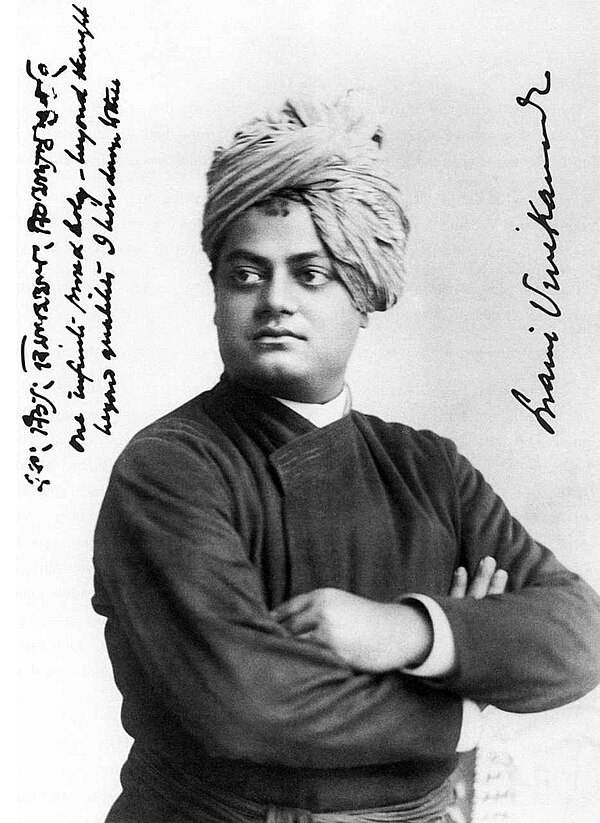
Seeing the Divine in Every Encounter
Swami Vivekananda invites us to perceive the divine essence within every individual, urging us to shift our perspective from mere assistance to genuine service. He emphasizes that our interactions with others should be rooted in the recognition of their inherent divinity, framing our actions as offerings to the divine rather than acts of charity. This profound understanding not only elevates our relationships but also transforms the nature of our service, making it a sacred duty rather than a transactional exchange.
In a world often marked by division and self-interest, this teaching holds immense significance. It challenges us to transcend our habitual ways of seeing others, encouraging a deeper connection that honors the divine spark within each person. By embracing this perspective, we cultivate a sense of unity and compassion that can profoundly impact our communities and ourselves, fostering a more harmonious existence.
The image / the metaphor
The imagery in Vivekananda's quote is rich and evocative, inviting us to envision every person as a manifestation of the divine. The verbs "look upon" and "serve" suggest an active engagement with the world around us, urging us to adopt a mindset that sees beyond the surface. This call to action is not merely about physical assistance; it is about recognizing the sacredness in every interaction, treating each person as a reflection of the divine presence.
Diving deeper into the metaphor, we find that this perspective transforms our understanding of service. It is not about elevating ourselves as saviors or benefactors; rather, it is about humbly acknowledging our role as instruments of divine love. In this light, service becomes a sacred practice, a way to honor the interconnectedness of all beings and to express our devotion to the divine through our actions.
In the speaker's tradition
Swami Vivekananda's teachings are deeply rooted in the Hindu tradition, where concepts such as dharma and bhakti illuminate the path of service. Dharma, or righteous duty, calls upon us to act in accordance with our higher purpose, while bhakti emphasizes devotion and love for the divine. By serving others, we fulfill our dharma and express our bhakti, recognizing that in every act of kindness, we are serving the divine itself.
In the context of Vivekananda's teachings, we can draw parallels with the concept of kenosis, the self-emptying of one's own will for the sake of others. This idea resonates with the notion of selfless service found in the Bhagavad Gita, where Krishna instructs Arjuna to act without attachment to the fruits of his labor. Such teachings remind us that true service arises from a place of humility and surrender, allowing us to become vessels of divine grace.
Living the teaching
Consider a modern scenario where this teaching can be applied: a busy urban environment where individuals often rush past one another, absorbed in their own lives. In such a setting, taking a moment to genuinely acknowledge a stranger—a smile, a kind word, or a simple act of assistance—can transform a mundane interaction into a sacred encounter. By recognizing the divine in that person, we not only uplift them but also enrich our own experience, fostering a sense of connection and community.
This teaching can also manifest in our personal relationships. Imagine a moment of conflict with a loved one, where frustration and misunderstanding cloud our perception. By consciously choosing to see the divine presence in that person, we can approach the situation with compassion and empathy, allowing us to navigate the conflict with grace. This shift in perspective can lead to deeper understanding and healing, reinforcing the idea that every interaction is an opportunity to serve the divine.
A reflection
As we contemplate Swami Vivekananda's profound words, we are invited to reflect on our own interactions with others. How can we cultivate a mindset that sees the divine in everyone we encounter? In what ways can we transform our acts of service into expressions of love and reverence for the sacredness of life? This inquiry not only deepens our understanding of service but also enriches our journey toward spiritual awakening.




Join the BrightStar Community
Stay connected with daily inspiration, event announcements, and community wisdom